
Gray County Deed Types
Deeds share shelf space with plenty of company at the Gray County Register of Deeds. Mortgages, easements, oil and gas leases, affidavits, liens, UCCs, releases, tax liens, and plats all sit in the same property records system. A deed records a transfer of an interest in land. Its type and wording carry real weight. The label on the instrument alone is never a promise that title is clear.
| Deed Type | What It Does | Common Use |
|---|---|---|
| Warranty deed | Conveys the stated interest with covenants written in the instrument | A conventional sale |
| Quitclaim deed | Conveys whatever interest the grantor has, if any | Family or title-cleanup transfer |
| Trustee deed | Conveys through a trustee acting under stated authority | Trust administration |
| Executor or administrator deed | Conveys from an estate through an authorized representative | Probate-related sale |
| Sheriff or tax-related deed | Records a transfer following a statutory or court process | Judicial or delinquent-tax proceeding |
Not every filing in the deed books actually conveys land. A mortgage, lien, lease, or easement may burden the property or grant someone use of it without replacing the owner of record. Read Gray County deed records alongside the later releases, assignments, and amendments that match the same legal description.
How Gray Deeds Are Indexed
Every filing that reaches the Gray County Register of Deeds gets a timestamp, a book, and a page. Documents are indexed by legal description. Per the county, this happens the next business day. That timing matters after a closing. A fresh deed can show up in the recorder's system well before the annual appraiser tax roll carries the new name. Write down the timestamp or recording date, book and page, parties, instrument type, and the full legal description. City land needs lot, block, and addition or subdivision. Metes-and-bounds land needs section, township, and range. These details keep the chain tied to the land. Even an owner name change or a new street address cannot break that link. Note: The county has not published the earliest year covered by its current or Old Document Search.
Gray County DMS Controls
The Document Search DMS page links both a current search and an Old Document Search. The public landing page displays Type, Event Date, and Print controls. The county does not publish the full document-type list, the exact party-name tabs, image price, account terms, result cap, or earliest coverage year.
| Control | Type | Required | Verified use or limit |
|---|---|---|---|
| Your Search | Search entry or heading | Not stated | Dynamic format was not exposed |
| Type | Filter | Not stated | Options cannot be safely guessed |
| Event Date | Date control | Not stated | Exact range format was not exposed |
| Old Document Search | Link | Not applicable | Separate historical search route |
| Button or link | Not applicable | Page-level print control |
Open the official county page itself before trusting any search label.
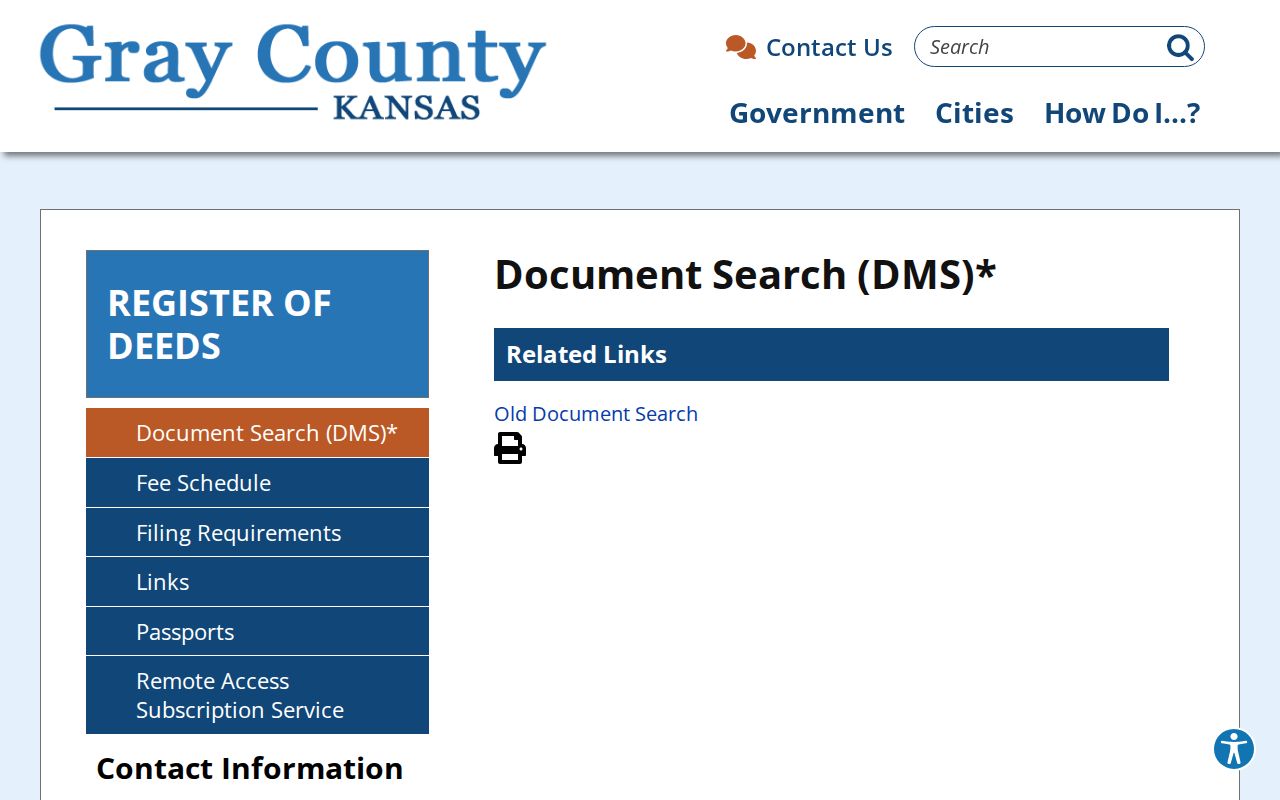
This image shows the county landing page, not a sample deed result. A live result still needs party, date, book/page, and legal-description checks.
Follow Gray County’s Deed Chain
A grantor-grantee trail always runs backward from the newest reliable transfer. Pull the owner spelling and book/page references from the Appraiser parcel detail first. Search that person or entity as a grantee. Then open the newest deed tied to the same legal description. The deed names the prior grantor, and that name becomes your next earlier grantee search.
- Find the latest deed by searching the current roll owner as grantee and matching the legal description.
- Copy the grantor, grantee, recording date, book/page or instrument reference, and deed type.
- Search the prior grantor as a grantee in older records. Keep the land description fixed.
- Repeat through name variants, trusts, estates, or re-plats until the online route ends.
- Ask the Register of Deeds for vault or microfilm access when the web index no longer carries the chain.
- Grantor
- The party that conveys the stated interest.
- Grantee
- The party that receives the stated interest.
- Chain of title
- The linked sequence of instruments affecting ownership of the same land.
- Book and page
- The placement assigned to a recorded instrument in county records.
- Instrument number
- A distinct filing reference when one appears in the index or document.
Keep Gray Land Descriptions Fixed
Names alone can build false chains. Gray County property records hold filings by people, businesses, trusts, estates, and joint owners. Those names may shift over time. Rural land gets described by quarter-section, section, township, range, acreage, and right-of-way exclusions. City land is more often tied to a lot, block, addition, or subdivision. Compare each deed's legal description to the one before it. Wording that changes points toward a plat, replat, vacation, annexation, split, or combination. Cimarron ordinance records name Cedar Ridge, Bainter Addition, and a partial Third Street vacation in N Aden Subdivision. Those municipal records can steer you toward an instrument. But the recorded plat or deed remains the land-record source. Mineral and access interests demand the same discipline. Gray County records oil and gas leases alongside easements and rights-of-way. One rural deed may convey the surface. A separate filing covers a lease, royalty, road, or utility right. Search the land description and party names for later assignments, releases, amendments, or satisfactions. A clean appraiser page cannot show that every such interest ended.
Gray Deed Filing Requirements
The county's filing requirements spell out what the office can accept. Instruments need original signatures and an original, legible notary. A photocopy cannot be recorded unless it is a certified copy from another recording office. The document must be readable, with the notary seal and expiration date visible. Gray County returns documents within 24 hours after filing. The office indexes them the next business day. Anyone conveying or receiving real property should supply a full name and last-known post-office address. That address goes to the County Clerk for tax mailing. It does not prove where the grantee lives or occupies the land.
Gray County Deed Fees
Copy fees at the Register of Deeds are simple. A document copy costs $1 per page, and an index copy runs $3. Certification of an instrument adds $13. Recording runs on its own scale. The published schedule lists $21 for the first page of an ordinary deed, mortgage, or other instrument, with $17 for each added page.
A town plat costs $32 per page. One-page mortgage releases or assignments carry a $20 charge, plus $4 per added page and $16 for each added book and page cited. Acknowledging a signature runs $12.50. Because document length and cited entries can change the total, confirm the current charge with the office before filing.
Gray Deeds Below the Web
Gray County keeps its oldest deeds the old-fashioned way. Paper land records sit in the courthouse vault. Microfilm copies rest in Hutchinson's underground salt mines. That two-step preservation chain matters more than it might first appear, because the county publishes no online cutoff year, so a blank web result never proves an older deed is missing.
For the earliest transfers, the Kansas Historical Society land-record collection picks up the trail toward first federal patents. Kansas tract books are arranged by section, township, and range, not by owner name. Even so, they can show the legal description, acreage, price, grantee, date, and law under which the land was acquired. Later transfers return to Gray County deed records.
History adds a wrinkle. The county was established in 1881 and organized in 1887 from Foote County and part of Buffalo County. Very early searches may need predecessor geography too. The county-seat fight offers another clue. Offices moved to Ingalls in 1887 before litigation settled the seat at Cimarron. When a nineteenth-century reference names a town that seems out of place, search under both names while holding the legal land grid constant. Local newspaper reels can explain the event itself. The deed book still supplies the transfer evidence.
Request a Gray County Deed
Start with the online index. Then request an ordinary or certified copy by book and page, date, party names, and legal description. Renee L. Shriner serves as Register of Deeds, with Deputy Marda Hastings alongside her. The office sits at 300 S. Main Street, PO Box 487, Cimarron, KS 67835, and answers at 620-855-3835. Counter, phone, and mail still matter. They fill the gap when images are missing.
If a public land record cannot be found through the posted route, a focused Kansas Open Records Act request may seek inspection or a copy. Name the parcel, instrument type, date span, and format. KORA has limits, though. It will not create a title report. Nor does it force the county to digitize an analog book.
Because an index page, a document page, and a certified instrument carry different charges, ask which copy you need before paying. Start with plain review copies for a chain. Reserve certification for the instrument needing the office seal. If the index reference is uncertain, provide both party names and the legal description rather than asking staff to search an entire family name without a date range.
Recorded, not guaranteed. Gray County deed records show filed instruments, not a legal opinion on ownership, lien priority, boundaries, or unrecorded interests.