
Gray County Owner-of-Record Card
Ownership in Gray County begins with the County Appraiser's parcel roll. It links a name to one assessment account. It also supplies the keys for a deed check. The live portal does not publish its exact owner-field label or refresh lag, so read each field as part of a dated tax record. Preserve the name, mailing address, situs address, parcel or quick-reference ID, legal description, and deed references exactly as displayed.
| Owner name | The taxpayer or owner of record carried on the parcel roll; exact live label is not documented. |
|---|---|
| Mailing address | The destination for tax mail, which may differ from the property location. |
| Situs address | The land or building location used to identify the parcel. |
| Parcel key | The parcel or quick-reference ID returned by the Appraiser search. |
| Legal description | Lot/block/addition for city land or section-township-range for many rural tracts. |
| Deed reference | Book and page fields that point toward recorded instruments. |
The owner of record is not the occupant. A leased farm, a trust-held home, or a vacant tract can split owner, mailing, and situs details apart. The roll still helps. It ties those fields to one parcel. For any present-tense ownership decision, the recording date on the newest deed supplies the critical second date.
Check Gray County's Current Roll
Open the Gray County Appraiser Online Parcel Search and search the known address or parcel key. The county-linked description also supports owner, class, and quick-reference routes. Choose the result by legal description and parcel identity, not by a same-name match. On rural land, section, township, range, quarter-section, and acres may be more reliable than a modern road address.
Gray County appraises real and personal property as of January 1 each year. A portion of county parcels is reinspected each year within a six-year cycle. Those dates explain what the assessment roll is built to do: support uniform valuation and tax administration. It is not designed as a real-time feed of every closing.
Note: Copy the parcel result date and assessment year so a later reader knows when the current-owner claim was checked.
Verify Gray County's Current Owner
A roll name is only the first check. Verify the current owner against the newest recorded conveyance for the same land. Gray County timestamps each filed instrument. It assigns book and page and indexes by legal description the next business day. The online DMS page offers both current and Old Document Search routes. It publishes no earliest online year. Nor does the county document every live search field. Start with the roll's deed references, then search by owner name and legal description.
- Read the owner of record and parcel keys in the Appraiser result. Save the legal description exactly.
- Search the Gray County Document Search for the latest deed matching that land.
- Compare the deed's grantee, recording date, and description with the roll. A newer deed may explain a stale owner name.
- When the sources conflict, call the Appraiser about the roll and the Register of Deeds about the recorded instrument.
- Owner of record
- The party shown on a dated official roll for the parcel.
- Assessment roll
- The county record used to list and value property for tax administration.
- Situs address
- The parcel's physical location, distinct from its tax mailing address.
- Recording lag
- The time between a deed filing and a later update in another county system.
Gray County's Recent-Sale Gap
The most common owner conflict follows a recent sale. A deed can be recorded mid-year, while the Appraiser record stays tied to its January 1 cycle. No timetable is published. Do not count on a fixed number of days. Compare the deed timestamp, the roll year, and the exact legal description instead.
A deed naming a new grantee is stronger transfer evidence than an older roll name. The online index remains a finding aid, though. Pull the image or order a copy from the Gray County Register of Deeds. Copies cost $1 per page. The office keeps paper records in its courthouse vault, with microfilm stored in the Hutchinson salt mines.
Check both dates. The roll can trail a recent sale. Confirm the newest recorded deed before naming the current Gray County owner.
Gray County Parcel Detail Fields
A parcel detail page shows more than a name. Its documented structure can include property class, land value, building value, total value, tract description, deed Book1/Page1 through Book4/Page4, agricultural data, a tax-information link, and View Sketch. Those fields tie an owner result to the right tract. That prevents a same-name mix-up.
The official Gray County parcel-detail route displays those fields for any selected parcel.
Treat the detail as an Appraiser record, not a title certificate. Save its date, parcel key, and deed references.
Read Gray County Entity Owners
The current owner may be an LLC, corporation, trust, estate, or joint ownership. Copy the entity wording exactly. The Kansas Business Entity Search accepts a business name, Kansas business ID, or resident agent. Contains and Starts With modes widen the match. The tool connects an LLC name to its state filing and agent.
That state result does not replace the deed. A registered agent is a legal contact, not necessarily a landowner or occupant. Trust deeds may name both trustee and trust. Estate records may use executor, administrator, or "Estate of." Search those role words when verifying ownership, and keep the deed's legal description fixed so a similar entity name cannot cause a mix-up.
Compare Gray County Owner Addresses
Two different addresses follow one parcel around Gray County. The mailing address is where the tax bill travels. The situs address marks where the land or building actually sits. Gray County filing rules ask anyone conveying or receiving real property to give a full name and a last-known post-office address, and the Register forwards that address to the County Clerk for tax mailing records. That is why the owner of record may get tax statements in another city or state.
A mailing address proves none of the things people assume. It does not establish residence, possession, or which city has jurisdiction over the parcel. Postal names such as Cimarron, Copeland, Ensign, Ingalls, and Montezuma can reach past the incorporated limits. Before picking a city or county office for a permit or zoning question, confirm the municipal boundary against the legal description.
Check a Kansas Owner Entity
Ownership sometimes sits with a company rather than a person. When the Gray County current owner is a Kansas entity, the state's own records add status. They also add resident-agent context. The Kansas Secretary of State search is the place to look. It advises a less-common keyword and caps results at the first 200 matches.
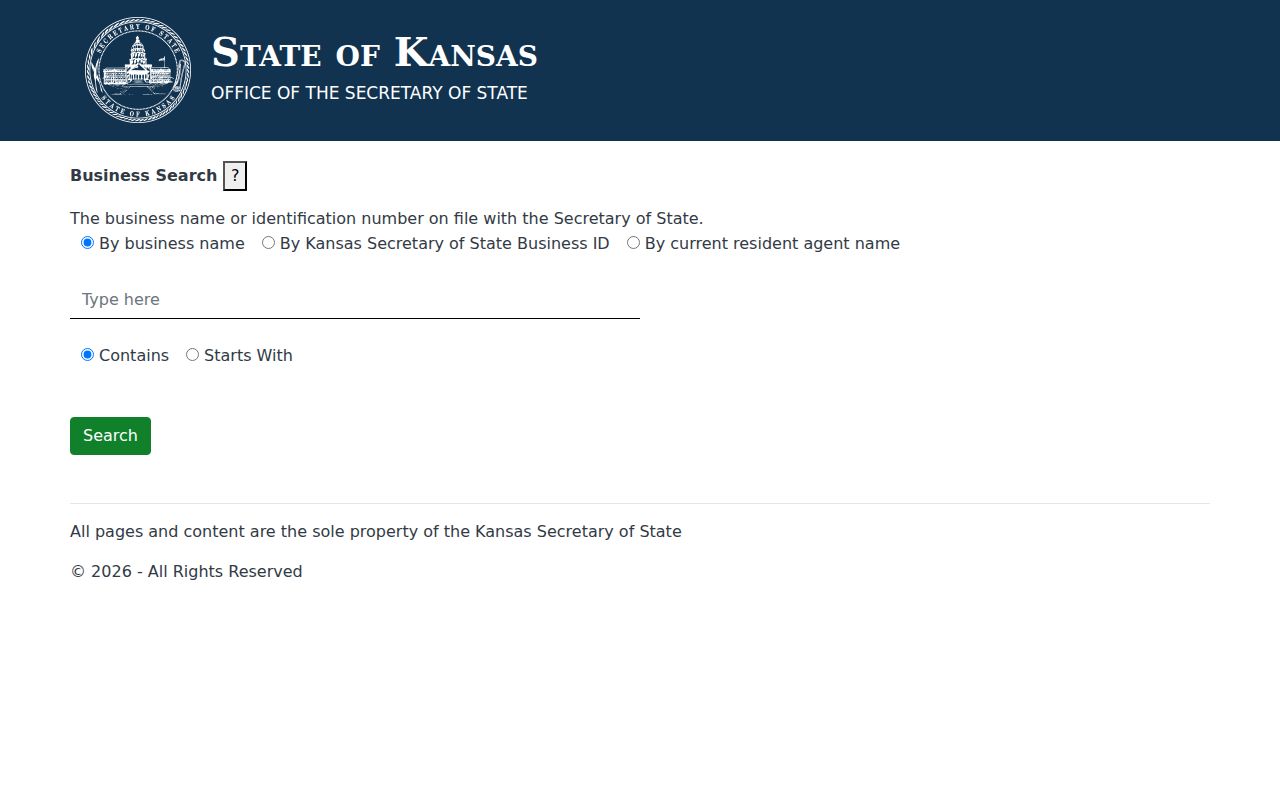
Treat that result as background on the entity named in the parcel and deed records. The recorded instrument still controls who holds the land interest.
Resolve Gray County Owner Conflicts
A mismatch between the tax roll and a recorded deed is common in Gray County. Each office holds only part of the answer. The Appraiser maintains the parcel account and its owner field. The Register of Deeds knows which instrument was filed last. That office can confirm the timestamp and the book and page. The County Clerk handles the tax roll itself and the tax-mailing address. Ask each office about its own records. None of them will issue a legal title opinion on ownership.
Before calling, gather the parcel number. Bring the legal description too. Collect any owner spelling variants, the assessment year, and the deed recording date with its book and page. Some documents still require a courthouse visit or a phone request. The Kansas Open Records Act lets you ask for an existing public record. You must simply describe it well enough to identify it. The county does not have to build a new owner report for you. For the wider address-to-owner method, see who owns Gray County property.
Contact a Gray County Owner Lawfully
A tax-mailing address in Gray County property records can reasonably open a conversation about a purchase, a boundary, an easement, an estate, or a recorded document. It is not a home address. Treat it as a mailing point only. Some records carry redacted or protected information, and Kansas Safe at Home lets eligible participants use a substitute address with public agencies.
State law also limits how these lists are used. K.S.A. 45-230 bars selling, giving, or receiving names and addresses pulled from public records in order to sell property or services. Keep any contact brief. Be truthful, and tie it to the property matter. The owner of record is not permission to track an occupant or push someone who declines contact.
Lawful use. Use a Gray County owner address only for a legitimate property matter. Never stalk, threaten, intimidate, or harass anyone.