
Gray County Tax Record Fields
No single office holds the whole tax picture. Gray County property tax records are split across three custodians. A parcel detail shows class plus separate land, building, and total values. The clerk turns certified values and taxing-unit levies into the tax roll. The treasurer keeps the billing, collection, receipt, and delinquency side. The county publishes no separate searchable tax-bill interface. The treasurer remains the direct route for current status.
| Field | What It Shows | Where |
|---|---|---|
| Class and appraised value | Property type and valuation basis | County Appraiser parcel detail |
| Land, building, and total | Components of the parcel valuation | County Appraiser parcel detail |
| Assessed value | Taxable amount after the Kansas assessment ratio | Appraiser and Clerk tax roll |
| Levy and special assessment | Taxing-unit rates and parcel-specific charges | County Clerk |
| Bill and installments | Amount due and first or second half | County Treasurer |
| Payment or delinquency | Receipt, unpaid status, and tax-sale inquiry | County Treasurer |
Appraised value, assessed value, and tax due are related figures, but they are not interchangeable. Agricultural land gets valued differently. Its assessment rests on productivity, not on ordinary market treatment. A tax record also proves nothing about title. For ownership transfer evidence, go to the latest recorded deed.
Search Gray Tax Parcels
The Gray County Appraiser Online Parcel Search is the online entry point for parcel work. It accepts owner name, property address, class, parcel ID, and quick-reference ID. Choosing a result can open tax information and a sketch. Treat it as a lookup tool, though. It is not a full tax-payment portal. Current balance questions still belong with the treasurer.
| Search mode | Input | Tax use | Limit |
|---|---|---|---|
| Owner | Name text | Find one owner’s assessed parcels | Entity and same-name matches need review |
| Address | Street text | Find a known site | Mailing name may not mark city limits |
| Class | Filter | Narrow by property classification | Exact choices were not exposed |
| Parcel ID | Identifier | Open the exact tax unit | County format is not published |
| Quick Reference ID | Identifier | Return to a known parcel | Copy it from the county result |
Before calling the treasurer about a balance or payment, copy down the parcel key, legal description, value year, and class. Those details keep the question from landing on the wrong tract.
Gray County’s Annual Tax Cycle
Gray County appraises real and personal property as of January 1 each year. Partly complete new construction is valued by its percentage of completion on that date. The Appraiser also reinspects part of the county each year under a six-year cycle for all parcels. Staff review sales, construction, demolition, measurements, building traits, and neighborhood conditions.
The official property tax calendar places valuation notices around March 1. The owner has 30 days from the notice mailing to appeal. The Appraiser certifies values by June 15. Tax statements are due to be issued for the December 20 payment date, with the second half due May 10 of the next year.
The calendar capture below is useful when planning a Gray County property tax review.
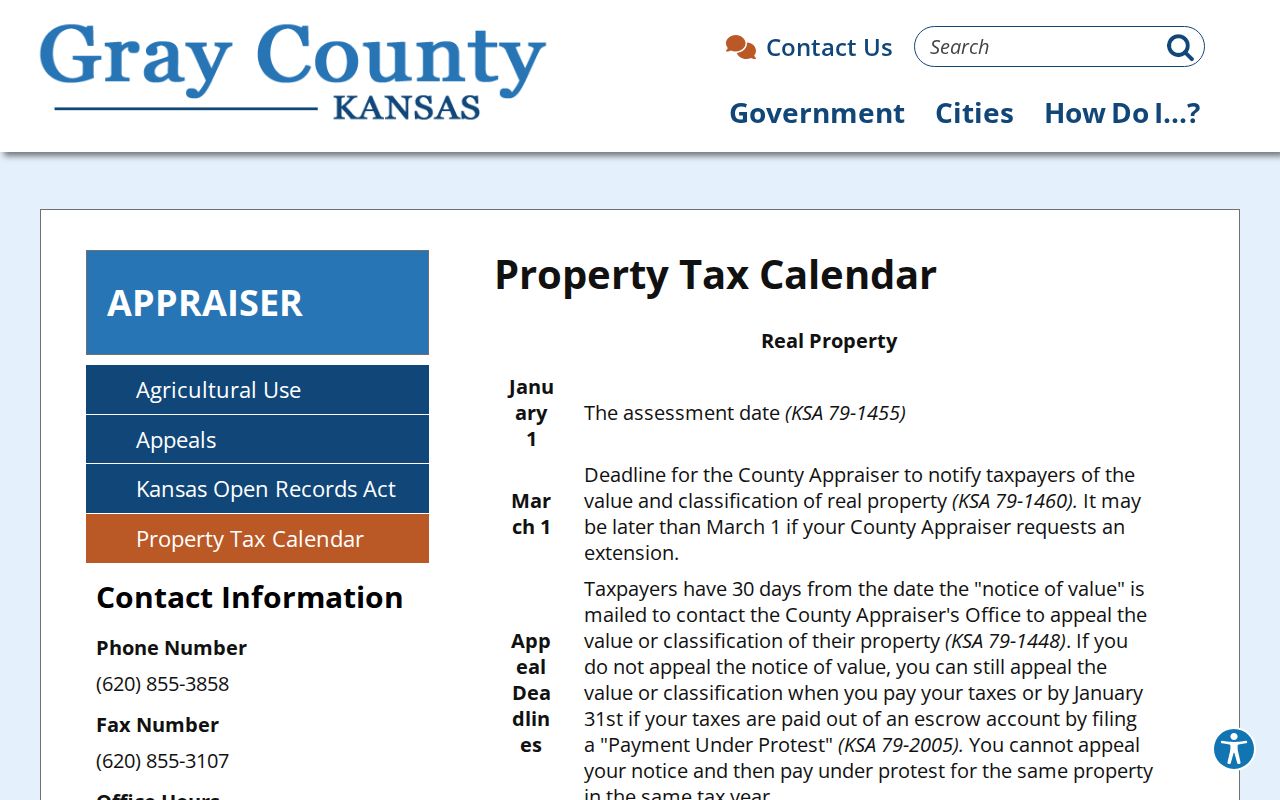
Check the published dates against the notice your parcel actually received. The appeal clock runs from the mailing date, not the calendar page.
Gray Property Assessment Ratios
Kansas converts appraised value into assessed value through class-based ratios. The state schedule sets residential property at 11.5 percent. It sets vacant lots at 12 percent. Commercial and industrial property sits at 25 percent. Agricultural land and improvements sit at 30 percent, while public utility property carries 33 percent. Those ratios explain why an assessed figure falls well below the full appraised figure.
Agricultural land is the big Gray County exception to simple market-value logic. Kansas constitutional, statutory, and state guidance base its appraisal on productivity. A parcel detail can list dry or irrigated acres, soil unit, irrigation type, well depth, acre-feet, and rate adjustments. It may also show program codes, agricultural use value, and agricultural market value.
Note: A ratio explains the assessment math. The taxing-unit levy and special assessments set the actual bill.
Look Up a Gray Tax Bill
Gray County publishes no separate online tax-bill search. Start with the appraiser parcel, then contact the Gray County Treasurer about balances, installments, receipts, delinquencies, protests, or tax sales. Kerry Schmidt is the Treasurer, and the office phone is 620-855-3861.
- Search the appraiser portal by address, owner, parcel ID, or quick-reference ID.
- Copy the parcel ID, legal description, owner spelling, tax year, and value fields.
- Ask the Treasurer for the current bill, first or second half, payment receipt, or delinquency status.
- Ask the County Clerk for the year’s levy, taxing units, or special assessment when the bill needs explanation.
- Compare any tax-sale or lien claim with the recorder and court record before drawing a title conclusion.
- Appraised value
- The appraiser’s estimate under the rules for the property class.
- Assessed value
- The taxable value after the applicable Kansas assessment ratio.
- Mill rate or levy
- The rate imposed by taxing units and applied to assessed value.
- Exemption
- A lawful exclusion or reduction reflected in the tax process when approved.
- Tax lien
- A claim tied to unpaid tax that requires record and status verification.
Gray County Tax Office Handoffs
The Appraiser discovers, lists, classifies, and values all taxable and exempt property. Maria Castillo holds the office, reachable at 620-855-3858. Copies cost $1 per page. The office collects no tax. Once values are certified, the County Clerk finalizes assessed amounts, applies levies and special assessments, and prepares the roll and statements.
Ashley Rogers is County Clerk, at 300 S. Main Street in Cimarron, 620-855-3618. Her office can supply the tax-year levy sheet, special-assessment record, budget source, or taxing-unit schedule. Published Gray County tables break out city, township, school, recreation, library, and hospital levies. The Treasurer then collects that revenue and distributes it to the taxing units six times a year.
Gray County’s 2026 Value Trend
The official 2026 market study reports residential change between roughly 2 and 8 percent. Most movement falls in the 3-to-6 range. Vacant land stayed stable. Commercial and industrial results ran mixed. Remember, these are market-study trends, not an automatic adjustment for every parcel.
Gray County is clear that the Appraiser does not create value. Market transactions supply evidence that staff analyze for individual values. That distinction matters whenever you review property tax records. A countywide trend can frame a question. But the parcel's own class, land, improvements, condition, location, and January 1 status decide its record.
Gray Delinquency and Tax Sale
The Treasurer comes first for unpaid real-estate taxes. The office handles payment history, statements, receipts, and routing into tax sale. Gray County posts no searchable delinquent list, no tax-sale calendar, and no redemption guide online. It publishes no payment-history export either. So treat a missing online list as no signal at all. A parcel is not clear simply because nothing appears.
Tax enforcement can span several offices at once. The Clerk keeps the roll and special assessments. The District Court may hold tax-lien enforcement orders. The Register of Deeds may record a resulting instrument. Give each office the same parcel number and tax year. Remember that a current tax status never proves ownership on its own.
Where no list is posted, KORA still works. A precise request can ask Gray County for a delinquent real-estate tax list, a tax-sale parcel list, or redemption records in a format the county already keeps. Copy and staff costs may apply.
Contest a Gray County Assessment
An owner who disagrees with the notice may appeal within 30 days of its mailing. Kansas law cited by the county is K.S.A. 79-1448. Useful evidence is tied to the parcel and valuation date: a correct legal description, photographs, measurements, condition facts, comparable sales, classification issues, and any construction or demolition status as of January 1.
Kansas also provides a payment-under-protest route under K.S.A. 79-2005. If no notice appeal was taken, a taxpayer may appeal when paying, or by January 31 when taxes are paid through escrow. The county calendar states that a notice appeal and same-year payment-under-protest cannot both be used for the same property. Confirm the required form and filing point with the Appraiser or Treasurer.
Appeal window. File within 30 days after the Gray County value notice is mailed. A later payment-under-protest route has separate timing and limits.
Gray Property Tax Payment Dates
The county calendar sets two deadlines. Full payment, or the first half, is due December 20. The second half falls due May 10 of the next year. When a mortgage company pays through escrow, it may receive the statement, so an owner should confirm receipt and status with the Treasurer rather than assume the bill was paid.
The Treasurer office page is the official online contact point. It confirms the office route, though no parcel-level tax-bill form appears on the county site.
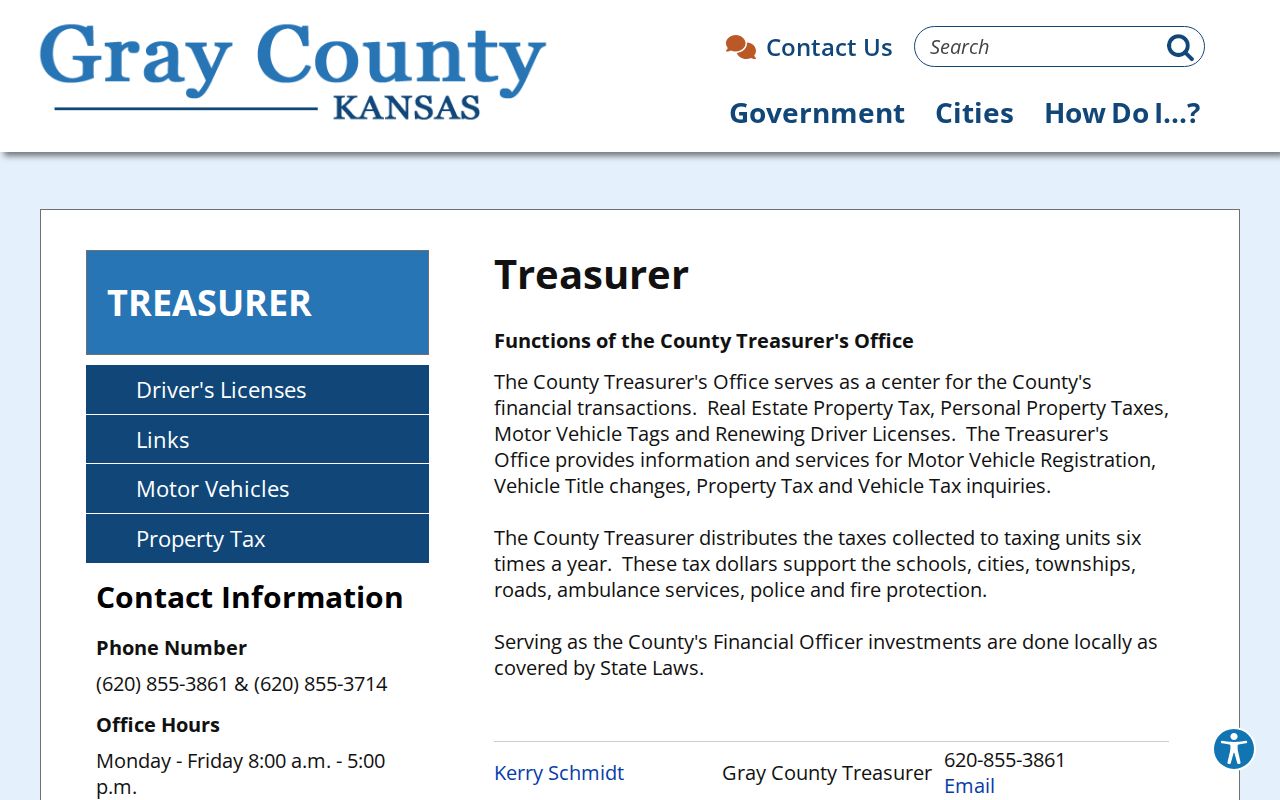
Always give the office the parcel ID and the tax year. That one habit keeps current and prior-year balances from blending together.
Limits of Gray Tax Records
A tax bill answers two questions. It shows how much was charged, and whether the Treasurer received payment. It proves nothing about surveyed boundaries, clear title, easements, or the legal effect of a deed. An appraised value is not a private appraisal. It is not a guaranteed sale price either.
For value questions, the Gray County property value material compares value types in detail. For taxes, keep the chain straight. The Appraiser sets value and class, the Clerk keeps the roll and levy, and the Treasurer issues the bill and takes payment. If the newest deed and the tax-roll owner of record differ, call the offices and compare dates. Assume neither source is wrong.